
What are the fastest-growing executive and leadership roles in 2026? It’s a common question asked by hiring managers and job seekers alike. The reality is that executive hiring in 2026 is being reshaped by structural forces rather than short-term cycles. A convergence of factors is creating new leadership priorities across the C-suite and senior executive layer, including:
- Digital acceleration
- Intense margin pressure
- Adoption of AI
- Increased investor scrutiny
While many organizations still rely on legacy role definitions, labor-market data shows that growth is concentrated in hybrid roles that unify strategy, execution, and measurable outcomes.
This analysis identifies the fastest-growing executive and leadership roles heading into 2026, using data from labor market reports, hiring platform trends, and enterprise leadership research.
What Defines “Fastest-Growing” Leadership Roles
For this report, a “fastest-growing” role is not defined by a single metric but by a convergence of qualitative and quantitative signals. These roles typically exhibit a combination of the following characteristics:
- Hiring Velocity: The role shows a significant and sustained increase in job postings and hiring rates over the past 12-24 months, outpacing other positions at a similar leadership level [1] [2].
- Cross-Functional Mandate: The position’s responsibilities inherently span multiple traditional business units, such as marketing, sales, product, and finance. This indicates a strategic response to organizational complexity.
- Linkage to Strategic Priorities: The role is directly tied to solving a top-tier business challenge, such as driving revenue streams, managing enterprise-wide transformation, or commercializing new technology like AI [3].
What Are the Fastest-Growing C-Suite Roles in 2026?
C-suite growth is increasingly concentrated in hybrid leadership roles that sit at the intersection of strategy, execution, and accountability.
Fastest-Growing C-Suite Roles (2026)
Role | Why Demand is Rising |
Chief Growth Officer (CGO) | Fragmented revenue ownership and slowing organic growth |
Chief Data Officer (CDO) | Need for enterprise data governance and AI readiness |
Chief Transformation Officer (CTO) | Post-merger integrations, cost restructurings, and large-scale charge initiatives |
Chief Revenue Officer (CRO) | Demand for predictable revenue execution across the entire customer lifecycle |
Key insight: These roles are expanding fastest where organizations lack a single executive owner for enterprise-level outcomes, particularly growth, transformation, and data governance. For example, hiring for Chief Growth Officers increased by 117.5% from 2019 to 2022, a direct response to the need for a single leader to orchestrate growth across departments [1].
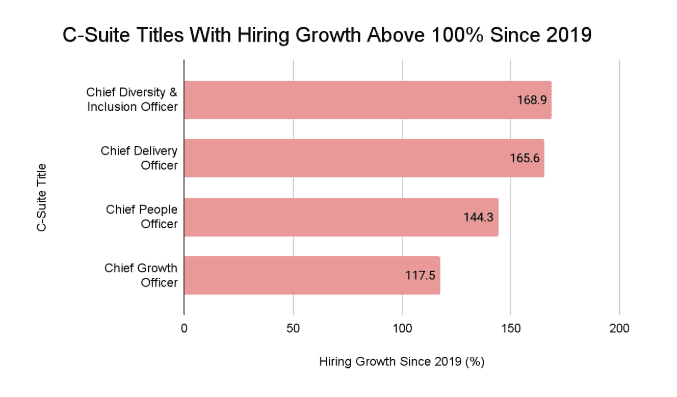
Four C-suite titles have experienced hiring growth exceeding 100% since 2019, led by Chief Diversity & Inclusion Officer and Chief Delivery Officer roles [1].
Fastest-Growing VP & Executive Leadership Roles
Below the C-suite, growth is accelerating in execution-oriented leadership roles tied directly to business outcomes rather than functional maintenance.
Fastest-Growing VP & Executive Roles
Role | Why Demand is Rising |
VP of Revenue Operations | Increasing complexity across sales, marketing, customer success |
VP of Product Growth | Monetization and retention pressure |
VP of People Analytics | Demand for data-driven workforce planning and cost optimization |
Head of AI / ML | The need to operationalize and commercialize AI investments |
While many recept reports focus heavily on new technical roles like AI Engineers, the explosive growth in those positions is directly fueling the demand for senior leaders who can manage them [2]. The need for a Head of AI/ML is a direct consequence of the rapid expansion of AI-focused teams.
What’s Driving Demand for These Roles
Across industries, several forces are driving leadership role expansion:
- Revenue fragmentation: Growth responsibility spread across too many functions creates execution gaps.
- AI and data commercialization pressure: Organizations need leaders who can operationalize AI, not just experiment.
- Investor and board scrutiny: Demand for measurable accountability at the executive level is rising
- Post-scale complexity: Companies growing past $100M revenue face coordination failures without new leadership layers.
- Talent scarcity at the senior level: The supply of leaders who can span strategy and execution remains constrained.
What These Trends Mean for Executive Hiring in 2026
Search strategies should focus on outcome ownership, cross-functional leadership, and adaptability rather than traditional functional tenure.
For companies:
- Role definitions must evolve faster than org charts
- Executive searches increasingly require hybrid skill profiles
- Mis-scoping leadership roles leads to longer time-to-impact
For candidates:
- Functional excellence alone is no longer sufficient
- Leaders with cross-functional ownership are seeing accelerated demand
- Experience integrating systems, teams, and metrics is a differentiator
As organizations prepare for 2026, executive hiring is shifting from replacement-based searches to capability-driven leadership design. With a 98% client success rate and a hiring process that is 3x faster than the industry average, Talentfoot is uniquely positioned to help companies acquire the transformational leaders they need.
When executive hiring becomes the next step in answering these questions, start here.
FAQs
At what company stage do these emerging leadership roles typically appear?
These roles most often emerge when companies reach roughly $75M to $150M in revenue or hit a major inflection point such as a merger, rapid expansion, or operating-model shift. At that stage, shared ownership begins to break down and execution risk increases.
Which of these roles are most often hired externally rather than promoted internally?
Chief Growth Officer, Chief Transformation Officer, and Head of AI / ML roles are more frequently filled through external search. These positions typically require experience building or integrating systems that do not yet exist inside the organization.
What are the most common mistakes companies make when hiring for these roles?
The most common issue is unclear mandate definition. Companies often hire these leaders without clearly aligning on decision rights, success metrics, or how the role fits alongside existing executives, which slows impact even when the hire is strong.
Sources
- George Anders, “Who’s vaulting into the C-suite? Trends changed fast in 2022,” LinkedIn, February 1, 2023.
- LinkedIn News, “LinkedIn Jobs on the Rise 2026: The 25 fastest-growing roles in the U.S.,” January 7, 2026.
- Gartner, “Top HR Trends and CHRO Priorities for 2026.”
- Talentfoot internal data