

In high-growth companies, onboarding salespeople is often treated as a necessary process instead of the strategic growth lever it actually is. But when new hires are brought in without clear expectations, structured ramp milestones, and manager-led coaching, the cost shows up quickly in missed forecasts, weak pipeline, slower productivity, and preventable turnover. The companies that scale sales teams successfully understand that onboarding is not just about helping reps settle in. It is about accelerating confidence, consistency, and revenue impact from the start. This article shows how high-growth companies can build a sales onboarding approach that improves ramp time, strengthens retention, and creates more predictable revenue performance.
TL;DR
High-growth companies should stop treating sales onboarding like orientation. The best onboarding programs define success before day one, translate expectations into a scorecard, focus the first 90 days on leading indicators rather than lagging revenue, and extend onboarding into a 6 to 12 month performance system. Done well, onboarding has real business impact. Organizations with strong onboarding practices have been shown to improve retention by 82% and productivity by more than 70%, while structured onboarding is also linked to higher long-term retention and stronger productivity.
Why sales onboarding breaks in high-growth companies
Most high-growth companies do not have an onboarding problem. They have a clarity problem.
A new sales hire joins with energy and potential, then gets flooded with product knowledge, internal meetings, CRM tutorials, shadow sessions, and messaging decks. Everyone believes the rep is being equipped to succeed. But within a few weeks, the real questions begin to surface. What exactly does success look like in the first 30, 60, and 90 days? Which activities matter most? What standards define a qualified opportunity? What should a manager coach first?
In many organizations, those answers are either vague or inconsistent. That is where onboarding begins to fail. Not because the rep lacks effort, but because the company has not turned expectations into an operating system.
This matters even more in high-growth environments. Fast-growing companies live with constant motion: evolving products, changing segments, shifting messaging, new managers, and rising revenue pressure. In that context, onboarding cannot be a static checklist. It has to function as a performance system. McKinsey’s work on organizational health reinforces this point by identifying strategic clarity and role clarity as key drivers of sustained performance. When people understand what matters and how success is measured, execution improves.
Onboarding is a revenue system, not a welcome process
The core mistake many companies make is designing onboarding around information transfer instead of measurable performance.
Traditional onboarding asks, “What does this person need to know?” High-performing organizations ask, “What must this person be able to do, consistently, by when?”
That shift changes the whole design.
A rep does not create pipeline because they attended ten training sessions. They create pipeline because they can speak credibly to the ideal customer profile, run a disciplined discovery conversation, qualify properly, handle objections with confidence, and execute consistently inside the company’s sales motion. In other words, the goal is not familiarity. It is fluency.
This is one reason onboarding is so closely tied to business outcomes. Research highlighted by Harvard Business Review shows that organizations with strong onboarding can see dramatically stronger retention and productivity, while Gallup has found that only 12% of employees strongly agree their organization does a great job onboarding. That gap should concern any growth-minded leader. It suggests that most companies are still underestimating how much early clarity and manager involvement shape long-term performance.
Define success before day one
The best sales onboarding begins before the rep starts.
If success is undefined at the beginning, managers end up coaching reactively. Reps spend their first quarter trying to decode expectations instead of building momentum. This is where growth companies lose time they cannot afford to lose.
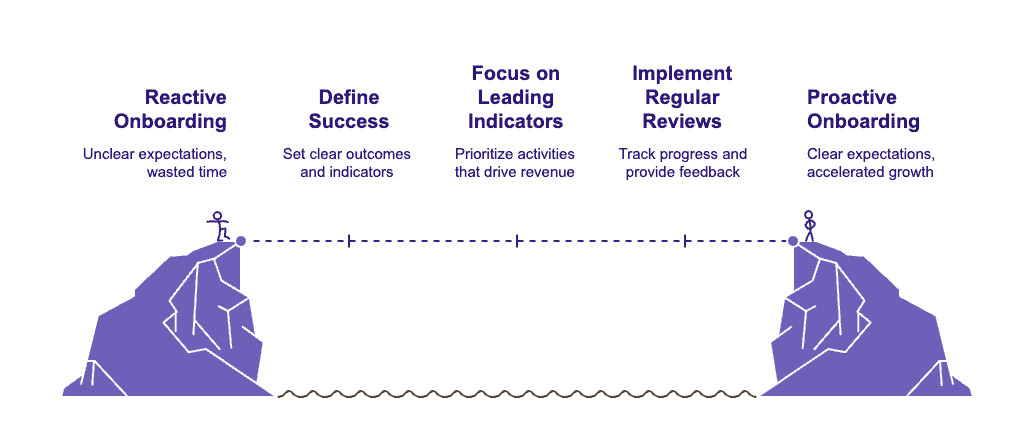
A better approach is to define success in stages. Before day one, leaders should be able to answer four questions clearly:
- What outcomes matter most in the first 30, 60, 90, and 180 days?
- What leading indicators best predict those outcomes?
- What behaviors distinguish healthy ramp from weak ramp?
- How and when will progress be reviewed?
For many high-growth sales roles, early success should be tied less to closed revenue and more to the leading indicators that create future revenue: qualified meetings, pipeline generation, conversion through early stages, CRM discipline, and the quality of discovery. That creates a more realistic and more coachable onboarding environment.
The deeper point is that clarity reduces wasted motion. Reps know what to prioritize. Managers know what to inspect. Leadership gets earlier signals on whether the ramp is actually on track.
Replace the job description with a scorecard
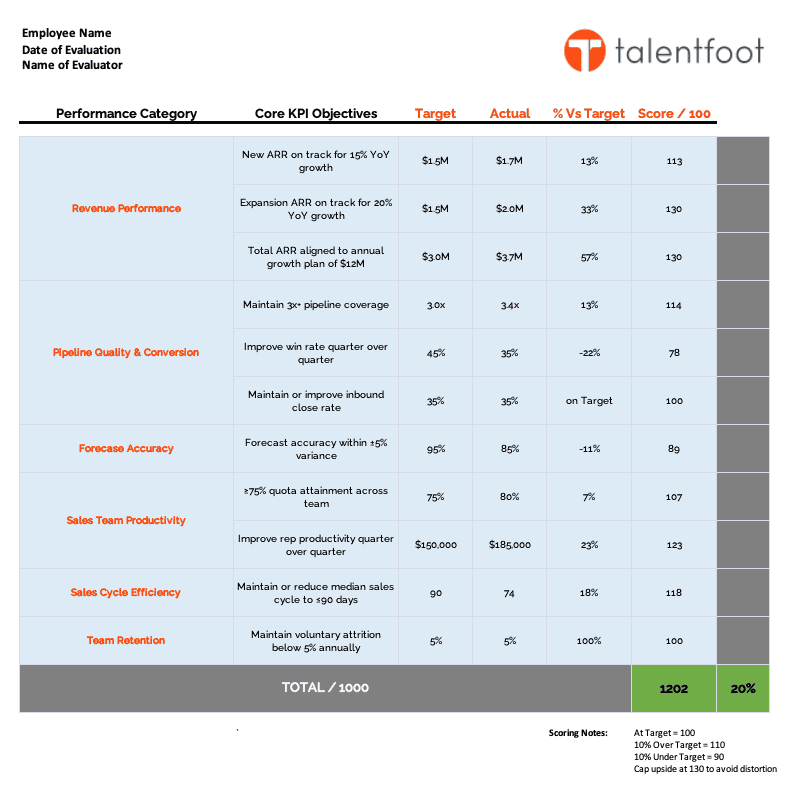
One of the most useful moves a growth company can make is replacing a generic job description with a scorecard.
Job descriptions tend to describe responsibilities. Scorecards define outcomes.
That distinction matters because responsibilities do not help a rep decide how to spend Tuesday morning. Outcomes do. A good scorecard turns a role into a handful of measurable priorities and the behaviors that support them. It gives the rep a blueprint and gives the manager a coaching framework.
A practical scorecard usually includes three elements:
- First, a small set of business outcomes the rep is expected to produce.
- Second, the leading indicators that signal those outcomes are likely to happen.
- Third, a regular review cadence that forces alignment and course correction.
This kind of clarity becomes even more important as companies scale. McKinsey’s research suggests that healthy organizations outperform not only because of talent, but because people understand how strategy translates into day-to-day execution. In onboarding, the scorecard is where that translation happens.
Treat the interview process as onboarding part one
Companies often talk about onboarding as though it begins after the offer is signed. In reality, the onboarding journey starts in the interview process.
When a new hire struggles to ramp, the problem is not always the onboarding plan. Sometimes it is that the company hired for experience rather than for operating fit. They hired someone who looked credible on paper but had not been tested against the actual thinking required to win in the role.
That is why the best hiring processes evaluate whether candidates understand how results are created. Can they explain the pipeline math behind their number? Can they connect activity levels to conversion rates? Can they diagnose weak performance using leading indicators rather than excuses? Can they adapt to ambiguity without losing rigor?
This is especially important in leadership hiring, where early failure is costly. Broader leadership research has shown that transitions into new leadership roles are fragile and often fail when expectations, support, and alignment are weak. The lesson for sales organizations is simple: the cleaner the hiring calibration, the cleaner the onboarding runway.
Build the first 30 days around fluency, not exposure
One of the most common onboarding traps is overvaluing exposure.
A rep can sit through product training and still be unable to run an effective discovery call. They can observe customer meetings and still struggle to articulate value in a way that creates urgency. They can complete systems training and still fail to maintain clean, trustworthy pipeline data.
The first 30 days should therefore center on capability building, not just content delivery.
That means helping new hires become fluent in the ideal customer profile, the core business problems buyers are trying to solve, the outcomes your solution creates, the structure of your discovery process, your qualification standards, and the non-negotiables of pipeline hygiene.
The goal is not to overwhelm the rep with everything. It is to make them reliable in the few activities that matter most early.
Manage the first 90 days with leading indicators
Growth companies frequently wait too long to determine whether onboarding is working because they evaluate it through lagging indicators like closed revenue.
That is usually too late.
In most complex or consultative sales motions, the earliest signs of ramp quality show up in behaviors and intermediate outputs: qualified meetings booked, quality of discovery, early pipeline created, conversion rates between stages, speed of follow-up, and CRM discipline. These are the metrics that tell you whether the rep is building a durable revenue engine or just staying busy.
This is also where many managers go wrong. They either over-index on activity volume or wait for outcomes that take months to materialize. The better approach is to connect activity to quality and quality to pipeline creation.
Onboarding becomes much more effective when managers are coaching these indicators weekly rather than reviewing them after the quarter is already lost.
Extend onboarding beyond day 90
Too many companies treat day 90 as the finish line. In reality, that is often when true performance management begins.
A rep may look fine at day 90 and still be building a fragile pipeline. They may be active but poorly qualified. They may have energy but weak forecasting instincts. These issues often do not become visible until months four through six, when managers expect predictability rather than promise.
That is why the strongest onboarding programs extend into a six to twelve month system. They continue to reinforce sales process discipline, forecast quality, opportunity strategy, pipeline coverage, and coaching tied to observed skill gaps.
This longer view is supported by the broader research as well. Gallup emphasizes that onboarding should help employees connect with expectations, purpose, and team dynamics early, while manager involvement remains one of the strongest drivers of whether onboarding actually works. Gallup has also noted that the effectiveness of onboarding is largely contingent on the manager’s active involvement.
Make onboarding a manager system
If there is one leadership principle worth emphasizing, it is this: sales onboarding should be manager-led.
Enablement, HR, and RevOps all play important roles. But managers are the people who translate expectations into daily behavior. They are the ones who review calls, inspect pipeline, challenge weak qualification, reinforce standards, and help the rep build judgment.
When onboarding is outsourced to content or workshops, it becomes an event. When it is embedded into manager rhythm, it becomes a system.
That rhythm does not need to be complicated. In fact, simplicity often works best:
- Weekly one-to-ones focused on leading indicators and one skill priority.
- Weekly call coaching that targets one or two behaviors, not ten.
- Biweekly pipeline reviews that reinforce qualification and next steps.
- Monthly scorecard reviews to spot risk before the number slips.
That kind of operating cadence creates accountability without chaos. It also makes onboarding feel less like a temporary stage and more like the first chapter of sustained performance.
Final thought
The highest-growth companies do not win because they hire great people and hope for the best. They win because they reduce ambiguity faster than their competitors.
That is what great onboarding really does. It converts optimism into execution. It transforms a promising new hire into a predictable contributor. And it gives high-growth companies a real advantage where it matters most: faster ramp, stronger retention, healthier pipeline, and fewer expensive hiring misses.
If you want to onboard salespeople effectively in a high-growth company, start with this question: have we made success unmistakably clear? If the answer is no, that is where the work begins.
Sales onboarding FAQs
Q: What is the best way to onboard salespeople for high growth companies?
A: The most effective approach is to define success before day one, create a scorecard tied to real outcomes, focus early coaching on leading indicators, and extend onboarding into a six to twelve month performance system.
Q: How long should sales onboarding last?
A: For high-growth companies, onboarding should typically last far longer than 30 or 90 days. In many cases, the most useful framing is six to twelve months, especially for complex sales roles.
Q: What metrics matter most during onboarding?
A: Focus on metrics that predict future revenue: qualified meetings, early pipeline created, conversion rates, stage progression, CRM hygiene, and call quality.
Q: Who should own sales onboarding?
A: Sales onboarding should be manager-led, with support from enablement, HR, and RevOps. Manager involvement is critical because managers shape priorities, reinforce standards, and coach behavior in real time.
Q: Why do sales hires fail to ramp?
A: Most do not fail because they lack effort. They fail because expectations were unclear, hiring calibration was weak, managers were inconsistent, or onboarding focused too much on information and not enough on execution.
Q: Does strong onboarding really improve retention and productivity?
A: Yes. Research cited by Harvard Business Review found that strong onboarding practices can improve retention by 82% and productivity by more than 70%, and other research has linked structured onboarding to stronger long-term retention and productivity. Talentfoot’s own research found that more than 80% of companies which adopted a structured, rigorous, and scorecard-based onboarding plan reduced voluntary and involuntary turnover within the first 180 days of a candidate’s hire.