
Nearly every technology executive entering the market today can speak confidently about artificial intelligence. Far fewer have led AI initiatives through the technical, commercial, and organizational realities required to create lasting enterprise value. That distinction is difficult to uncover through a traditional executive interview.
AI leadership candidates are often assessed against broad criteria such as technical credibility, strategic thinking, transformation experience, and executive presence. Those qualities matter, but they do not answer the most important question:
Is this executive built to solve the specific AI leadership challenge facing our organization now?
A leader who excels at advancing proprietary models may struggle to operationalize them. An executive who can build consensus across the enterprise may lack the technical depth to challenge an engineering roadmap. A proven operator may scale infrastructure effectively but fail to establish the long-term AI strategy the board expects.
These are not necessarily weaknesses. They are differences in leadership orientation.
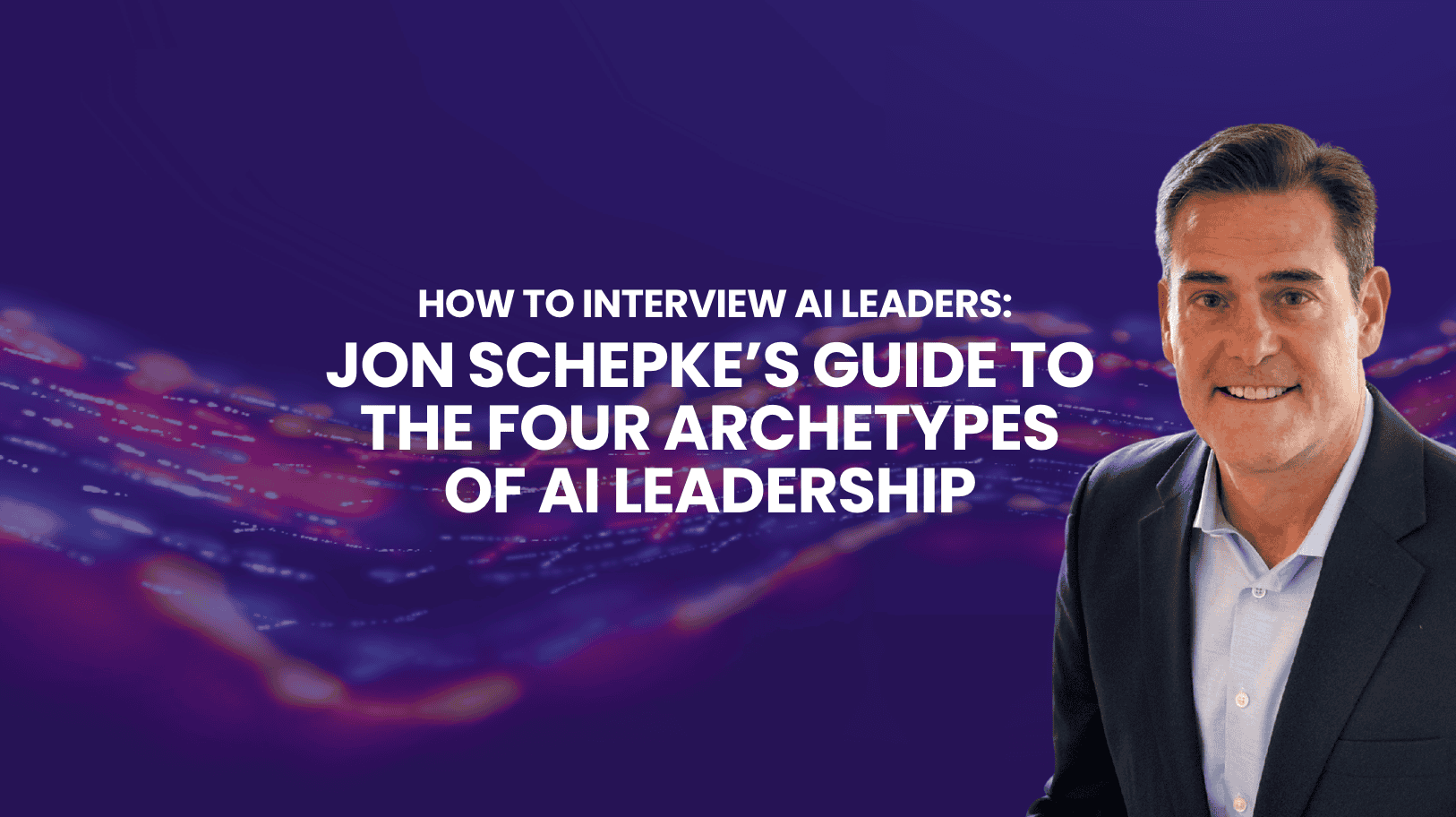
Talentfoot’s Four Archetypes of AI Leaders framework distinguishes among the Researcher, Builder, Translator, and Integrator. The framework gives hiring committees a more precise way to define the mandate, structure executive interviews, and distinguish genuine experience from polished AI fluency.
The objective is not to identify the candidate who sounds most impressive. It is to determine which candidate has repeatedly solved the kind of problem your business is hiring them to solve.
The 4 Archetypes of AI Leaders
| Archetype | Core objective | Hire when… |
|---|---|---|
| The Researcher | Push the frontier of what’s technically possible | Your organization is investing in core AI intellectual property, differentiated model development, or proprietary capabilities where technical depth is a competitive moat. |
| The Builder | Turn AI from concept into production infrastructure | Your AI direction has been validated, and the priority is moving from proof of concept to reliable, scalable deployment. |
| The Translator | Connect AI capability to business outcomes | The primary barrier to AI value is organizational adoption, and the business needs a leader who can build alignment, communicate impact, and drive change. |
| The Integrator | Lead AI across execution, strategy, and people at once | The organization is at a true inflection point and needs simultaneous progress across technical execution, strategic direction, commercial outcomes, and organizational adoption. |
No archetype is inherently better than another. The question is which one aligns with what the organization actually needs.
A brilliant Researcher hired into a scaling problem can struggle just as much as a Translator hired as a substitute for deep technical leadership.
Define the Leadership Problem Before Evaluating the Leader
The most consequential AI hiring decision often happens before the first candidate enters the process.
Hiring committees frequently begin with a title, a collection of desired credentials, and a broad mandate to “lead AI.” That approach creates an overly expansive profile and encourages interviewers to reward candidates who demonstrate general sophistication rather than specific fit.
Instead, the committee should align around three questions:
-
- What must be materially different about our AI capability within the next 18 to 24 months?
- What is preventing that outcome today: technical innovation, production capability, organizational adoption, or leadership alignment
- How is the mandate likely to evolve after the initial objective is achieved?
The answers reveal the leadership archetype the organization actually requires.
If the company’s competitive advantage depends on creating proprietary AI capability, it likely needs a Researcher.
If the strategy has been validated but remains trapped in pilots, it needs a Builder.
If the technology exists but the organization has not embraced it, it needs a Translator.
If progress depends on technical execution, enterprise strategy, commercial judgment, and change leadership moving together, the mandate may require an Integrator.
This distinction should shape more than the interview questions. It should inform the title, reporting structure, compensation, scorecard, executive sponsorship, and authority assigned to the role.
A well-run search does not begin by asking, “Who is the strongest AI executive available?”
It begins by asking:
What kind of AI leadership will create the most value at this stage of our business?
Interview for Evidence, Not AI Fluency
AI candidates are becoming increasingly skilled at discussing transformation, innovation, and future-state operating models. Hiring committees therefore need to move beyond conceptual answers and test for evidence.
The strongest executive interviews consistently probe for:
- Decisions the candidate personally owned
- Systems or capabilities that reached production
- Quantifiable business outcomes
- Tradeoffs made under imperfect conditions
- Resistance encountered across the organization
- Failures, reversals, and lessons learned
- Clear distinctions between the candidate’s contribution and the work of the broader team
Interviewers should also test the boundaries of each candidate’s leadership profile.
A candidate’s awareness of where they need complementary talent is often as revealing as the strengths they claim to possess.
The goal is not to catch candidates in a weakness. It is to understand the conditions under which they are most likely to create value.
How Do You Interview Each Archetype?
The Researcher
The Researcher should be evaluated on more than technical credentials, publication history, or familiarity with emerging models. At the executive level, the differentiator is whether the candidate can direct uncertain technical investment with discipline.
Ask:
“Walk me through a research direction you believed in that ultimately did not produce the expected result. What signals caused you to reconsider it, and how did you decide whether to continue, redirect, or stop the work?”
Then probe:
“How did you communicate that decision to executives or investors who may not have understood the technical complexity?”
A strong Researcher can explain not only what was attempted, but how hypotheses were formed, how evidence was evaluated, what resources were at risk, and how they protected the organization from pursuing technical novelty without sufficient strategic value.
Listen for: Intellectual honesty, disciplined experimentation, original contribution, and the ability to attract exceptional technical talent.
Red flag: The candidate cannot point to failed research directions, treats abandoned work as someone else’s failure, or cannot explain how research priorities connected to the company’s broader competitive position.
Hiring mistake to avoid: Bringing in a Researcher when the technical problem is largely solved and the real need is operationalization.
The executive-level question is not simply whether the candidate can push the frontier. It is whether they can determine which frontier is worth pursuing.
The Builder
Builders should be tested on the realities that emerge after an AI demonstration appears successful.
Ask:
“Walk me through an AI system you took from proof of concept to sustained production use. Where did the original assumptions break down, and what did you change?”
Probe for data quality, model performance, infrastructure cost, security, governance, latency, user behavior, monitoring, and adoption.
Then ask:
“At what point did you decide the system was reliable enough to scale, and who had to agree?”
A genuine Builder will describe AI as an operating system, not an isolated model. They understand that production success depends on architecture, data pipelines, workflows, accountability, and ongoing performance management.
Listen for: Practical judgment, experience navigating imperfect infrastructure, clear ownership of production outcomes, and a defensible framework for determining when something is ready to scale.
Red flag: The candidate talks almost exclusively about the model or prototype and cannot describe the surrounding infrastructure, production failures, or operational tradeoffs.
Hiring mistake to avoid: Assuming delivery capability automatically translates into enterprise leadership.
At scale, Builders must be able to secure resources, resolve cross-functional tension, communicate risk, and help nontechnical executives understand why production AI requires continued investment after launch.
The Translator
The Translator’s value is not simply communication. It is the ability to create shared conviction across groups that measure value differently.
Ask:
“Tell me about an AI initiative that initially lacked executive or operational support. How did you reframe the opportunity, and what changed as a result?”
Then probe:
“What specific financial, operational, customer, or risk outcomes did you use to build the case?”
Strong Translators move comfortably between technical possibility and commercial consequence. They can explain an AI investment to the board without reducing it to empty transformation language, and they can engage technical teams without overstating their own depth.
Listen for: Specific P&L, cost, risk, or customer impact; evidence that the candidate changed resource allocation or operating behavior; and a clear understanding of where their technical expertise ends.
Red flag: Vague technical language, generic transformation stories, or an inability to explain how adoption was actually achieved.
The best Translators understand that adoption is not achieved through communication alone. It requires incentives, workflow redesign, governance, training, and visible executive sponsorship.
Hiring mistake to avoid: Hiring a Translator as a proxy for technical leadership.
Communication fluency is not technical depth. Organizations that need both must staff for both.
The Integrator
The Integrator is frequently requested and rarely defined with sufficient rigor.
Many organizations describe an Integrator when they create a mandate combining strategy, architecture, commercialization, transformation, talent leadership, and board communication.
That does not mean every candidate who has touched each of those areas can truly operate across them.
Ask:
“Describe an AI initiative where you personally moved between a consequential technical decision and an executive or board-level decision. What was at stake in each conversation, and how were the two connected?”
Then go deeper:
“Which elements of the strategy were directly yours, which were owned by your team, and where did you rely on specialists?”
A genuine Integrator demonstrates range without resorting to abstraction.
They can defend technical tradeoffs, connect investment decisions to business strategy, establish a credible multiyear direction, and lead teams through the uncertainty created by AI-enabled change.
Listen for: Architectural decisions they can defend in depth, genuine strategic ownership, commercial judgment, and evidence of successfully leading organizational change.
Red flag: Vision described entirely in the abstract, superficial technical fluency, or a career narrative with no meaningful mistakes, tradeoffs, or failed decisions.
The strongest Integrators are not simply broad generalists. Their value comes from synthesis: the ability to recognize how technical architecture, operating models, talent, customer value, risk, and organizational behavior affect one another.
Hiring mistake to avoid: Assuming the Integrator profile can be recreated simply by combining several narrower leaders.
Because these executives are rare, hiring committees should resist labeling a polished Builder-Translator hybrid as an Integrator without testing for genuine strategic ownership and technical depth.
Turn the Interview Into a Decision System
A structured interview is only valuable when the evaluation process is equally disciplined.
Before interviews begin, the hiring committee should define the capabilities that are essential for the target archetype and distinguish them from those that are merely advantageous.
Each interviewer should then be assigned specific dimensions to assess rather than being asked for a general impression of the candidate.
Talentfoot recommends scoring candidates immediately after each conversation and before the panel debrief. This reduces the influence of the most senior or outspoken interviewer and prevents early consensus from becoming an unchallenged narrative.
The scorecard should capture four forms of evidence:
Depth: How sophisticated was the candidate’s direct experience?
Scale: At what organizational, technical, or commercial scale did they operate?
Ownership: What did the candidate personally decide, build, influence, or change?
Relevance: How closely does that experience align with the mandate ahead?
Hiring committees should be especially cautious with candidates who appear equally strong across every archetype.
True Integrators exist, but broad, uniformly positive scores can also indicate that interviewers rewarded executive polish rather than examining evidence deeply enough.
A candidate can be exceptional and still be wrong for the mandate.
The scorecard should protect the organization from confusing leadership quality with situational fit.
How Talentfoot Evaluates AI Leadership
Hiring an AI executive requires more than confirming technical credentials or transformation experience. The greater challenge is determining whether a candidate’s leadership strengths align with the specific business problem the organization needs to solve.
Talentfoot uses the Four Archetypes framework to bring greater precision to that decision. It creates a common language for the board, executive team, and search committee to define the mandate and evaluate leadership fit before personal chemistry or executive polish begins to influence the process.
Consider this framework a glimpse into the thinking behind Talentfoot’s approach. The full value comes from how it is tailored and applied to each organization’s strategy, stage, and leadership mandate.
Our assessment goes beyond titles and surface-level AI experience. We examine what candidates have personally built, scaled, influenced, and changed, as well as the organizational conditions in which they were successful.
This helps distinguish executives who can speak credibly about AI from those equipped to lead the next stage of the company’s strategy.
The result is not simply a slate of accomplished AI leaders. It is a more informed view of which leader is best suited to the organization’s priorities, operating environment, and future direction.
What Hiring Teams Should Take Away
There is no generic AI leader, and there should not be a generic process for hiring one. Before defining the title, writing the job description, or interviewing candidates, organizations need to be clear about what they expect AI leadership to accomplish over the next 18 to 24 months.
That starts with identifying the leadership profile the business actually needs. A Researcher, Builder, Translator, and Integrator each create value differently. The right choice depends on the organization’s strategy, stage, technical maturity, and the barriers standing between AI investment and business impact.
It also means interviewing for evidence, not fluency. Past-tense behavioral questions should uncover what candidates have personally built, scaled, changed, and learned. Shipped systems, measurable outcomes, clear ownership, difficult tradeoffs, and honest failures often reveal far more than a polished discussion of AI strategy.
Hiring teams should pay particular attention to the boundaries of a candidate’s experience. The strongest leaders understand where they add the most value, where they need complementary expertise, and how their leadership must evolve as the organization matures.
Does every organization need a Chief AI Officer?
No. A dedicated Chief AI Officer may make sense when AI requires enterprise-wide ownership across strategy, technology, governance, investment, and adoption. In other organizations, that mandate may sit more naturally with a CTO, Chief Data Officer, Chief Digital Officer, or another functional executive.
The title matters less than having clear accountability for the outcomes the organization expects AI to deliver.
Who should be involved in evaluating an AI executive?
The interview process should reflect the breadth of the mandate. Executive sponsors, technical leaders, business stakeholders, and human resources should each evaluate defined dimensions of the role rather than relying on general impressions.
Independent scoring before a group debrief can also help prevent executive presence, personal chemistry, or the opinion of the most senior interviewer from disproportionately shaping the decision.
Does the AI leader need to be the most technical person in the organization?
Not necessarily.
The required level of technical depth should match the mandate. A Researcher or Builder will typically require deeper hands-on technical credibility, while a Translator or Integrator may create greater value through a combination of technical fluency, commercial judgment, strategic leadership, and organizational influence.
The important question is not whether the executive is the deepest technical expert in every room. It is whether they have enough depth to make sound decisions, challenge assumptions, earn credibility, and know when deeper expertise is required.
How should success be measured?
Success should be defined before the search begins and tied directly to the reason the leader is being hired.
Depending on the mandate, that may mean advancing proprietary AI capabilities, moving systems from experimentation into production, increasing enterprise adoption, delivering measurable financial impact, strengthening governance, building critical talent, or establishing a multiyear AI strategy.
The measures will differ by archetype. What should not differ is the expectation that AI leadership ultimately creates measurable business value.
The Bottom Line
The biggest mistake organizations can make is treating AI leadership as a credentialing exercise: find the person with the strongest technical pedigree, the most recognizable companies on their résumé, or the most compelling vision for AI.
The better question is more specific:
What does our organization need this leader to make true that is not true today?
Answer that first, and the rest of the search becomes sharper. The role becomes clearer. The interview questions become more revealing. The scorecard becomes more meaningful. And the organization is far more likely to hire a leader whose strengths match the work ahead.
The future of AI leadership will not be defined by a single ideal executive profile. It will be defined by organizations that understand precisely what kind of leadership their next stage requires, and have the discipline to hire for it.