
The media agency landscape has changed dramatically over the last decade. Client expectations have evolved, technology has reshaped how work gets done, and the leaders who succeeded in the traditional agency model are not always equipped to lead through what comes next.
Today’s strongest agency executives need more than deep relationships and channel expertise. They must understand data, connect media decisions to business outcomes, lead through constant change, and help clients navigate emerging technologies such as AI and automation.
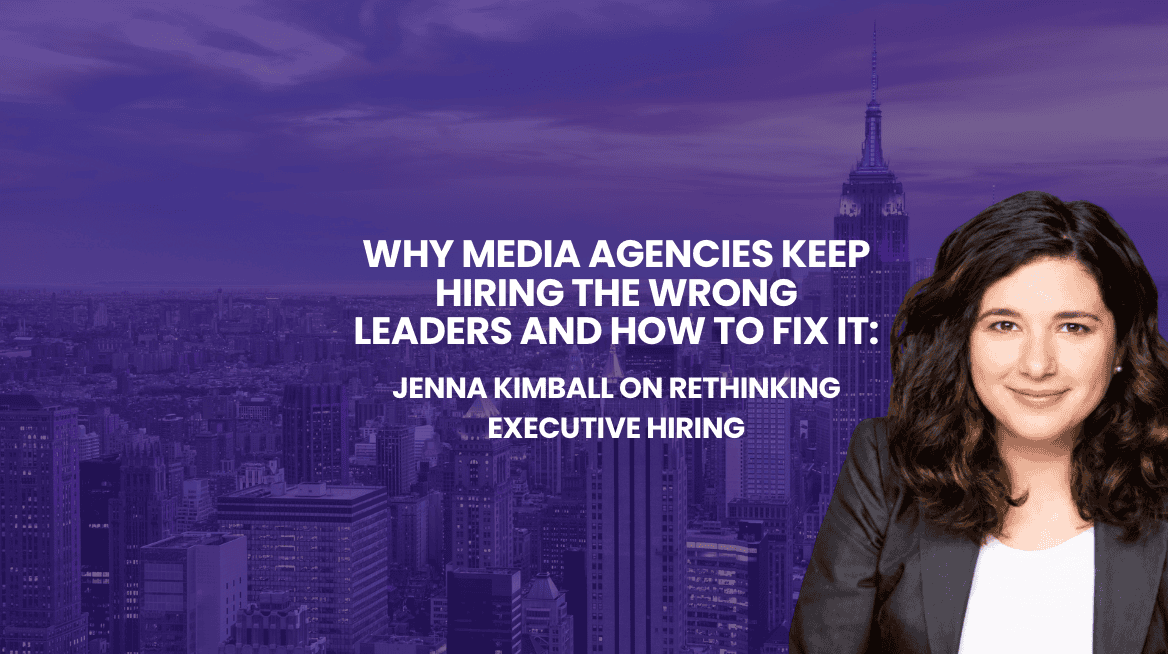
To explore why media agencies continue to miss the mark on executive hiring, we sat down with Jenna Kimball, Talentfoot’s newest Senior Marketing Recruiter. Jenna specializes in recruiting marketing and sales leaders across advertising, media, financial services, professional services, retail, healthcare, eCommerce, and B2B environments.
Known for her ability to quickly understand a client’s business, role requirements, and market dynamics, Jenna brings a practical perspective on what modern agency leaders need to succeed. In this interview, she shares where traditional hiring processes fall short, how to assess data fluency and change leadership, and why agencies must define the future of the role before they begin evaluating candidates.
Her perspective is clear: media agencies cannot build for the future while continuing to hire for the past.
How the Media Agency has Shifted
Q1: Jenna, how would you describe the biggest structural changes in media agencies over the last decade? What does the landscape look like now compared to ten years ago?
Ten years ago, the senior agency executive was, above almost everything else, a relationship manager. They knew the clients, they knew the media owners, and they were trusted because of the depth of those connections. The model rewarded tenure, access, and personality. The work itself, media planning, buying, campaign management, was largely executed by layers of people beneath them.
That model has been under sustained pressure from every direction. Clients have brought more capability in-house. Consultancies moved into strategy. Holding companies have consolidated and squeezed margins. And technology has automated or commoditized significant portions of what agencies used to charge for.
What is left is more complicated and, in many ways, more interesting. The agencies that are winning are leading with business solutions, not channel proposals. They are embedding themselves in their clients’ business problems rather than selling media solutions. They have proprietary data capability and analytics infrastructure that creates real switching costs. The leaders those agencies need look fundamentally different from the ones who built the industry.
The tension inside most agencies right now is that the old model and the new one are running simultaneously. The relationships still matter. The traditional buying expertise still has value in certain contexts. But the center of gravity has shifted, and the executives who have not shifted with it will be left behind, and will bring their agency right behind with them.
How Executive Skillsets Have Changed
Q2: What skills are now non-negotiable for a senior agency leader that would have been considered niche or optional ten years ago?
Data literacy is the clearest one. Not the ability to run analyses personally, but genuine fluency: the ability to ask the right questions of data, interpret what it means for a client’s business, and make decisions from it. Ten years ago that was a specialist skill. Today it is a baseline expectation for any executive in a planning or investment leadership role, and the candidates who do not have it are visible almost immediately in a conversation.
The second skill is they need to understand the whole media landscape and how all of it fits together beyond their function/department. And, they need to be adaptable at learning how the latest platforms and technologies impact that landscape. They can’t just own their domain anymore; they have to stretch into other areas, at least broadly.
The third is the ability to operate as what I like to call a mini-business owner. The best senior agency leaders advise clients based on their business problems rather than starting with a channel recommendation. They walk into a room and get to the heart of what the client is trying to achieve commercially before saying anything about media.
That sequence, business outcome first and media solution second, sounds obvious, but it is genuinely rare and is almost never assessed well in an interview. These mini-business owners treat the client’s business as if it were their own and can connect their decisions and results directly to revenue.
What Most Media Agency Interview Processes Get Wrong
Q3: What are the most common mistakes you see media agencies make when interviewing executive candidates? Where does the process break down?
The most common mistake is asking questions designed for the role the agency used to need, not the role it actually needs now, or two years from now. I still see interview processes that center on client relationship history, traditional media buying experience, and cultural fit defined as comfort with the existing leadership team. Those are important, but not a comprehensive rubric. And when those “qualifications” dominate the process, you end up selecting a “new” executive for the old model.
The second mistake is that there is rarely alignment among interviewers before the process begins on what they are evaluating. Sure, one person is assessing culture fit, another focuses on client skills, another on media knowledge, but nobody has agreed on what a strong candidate looks like across all three dimensions. This causes the debrief to become a “vibe check” or negotiation between competing impressions rather than a structured evaluation of evidence against a hiring rubric.
The third mistake is confusing confidence with competence. Senior agency executives are often exceptional communicators. They have spent their careers presenting to clients, running pitches, and performing in high-stakes rooms. That polish can mask significant gaps in technical fluency or strategic depth, and most interview processes do not push far enough beneath the surface to uncover them. As a result, a compelling communicator may be hired into a role where they are ultimately accountable for outcomes no one fully assessed their ability to deliver.
Q4: How do you evaluate a candidate’s data and analytics fluency in an interview without turning it into a technical test? What language or framing reveals real depth versus surface-level familiarity?
The best signal is whether someone can connect data to a business decision, because that allows you to evaluate both data fluency and business fluency at the same time. I do not ask candidates to define terms or explain methodologies. I ask them to walk me through a situation where data changed how they thought about a client’s media strategy, including what the data showed, what it meant, and what they did differently as a result.
If I think a candidate is dancing around my question, I will say, “Explain it to me like I’m your grandma.” Candidates with real fluency tell specific stories. They know what the data said, why it was surprising or clarifying, and how it influenced the recommendation. Candidates with surface familiarity tend to speak in generalities. They talk about the importance of being data-driven. They describe their organization’s analytics capability rather than their own relationship with it. They use the right vocabulary but cannot populate it with a real example. It’s like hearing someone read a textbook rather than retelling their life experience. Big difference.
The follow-up question that separates them is simple: what was the limit of what that data could tell you? Strong candidates have thought about this. They know what the data could not answer, what assumptions they had to carry, and where judgment filled the gap.
How to Interview for the Skills That Actually Matter Now
Q5: How do you assess whether someone can lead through ambiguity and organizational change, which is constant in agencies right now, rather than simply manage a stable team?
I ask about the hardest period they have navigated, not the most successful one. Agencies are in almost constant transition right now, including restructuring, re-pitching, adopting new technology, and managing pressure from holding companies. Executives who can lead through that environment have usually done it before, and they can describe exactly what it looked like.
What I listen for is whether they were the source of stability or the source of inaction for their teams during that period. Did they create clarity when there was none? Did they make decisions with incomplete information and stand behind them? How did the people around them react to that transitional period? Can they admit if they didn’t handle aspects of the change well?
The candidates who struggle to answer this tend to describe change as something that happened to them and their teams rather than something they shaped. They talk about surviving turbulence rather than navigating it. That is a meaningful difference in an environment where the turbulence is not going to stop. How are you supposed to be a pilot if you can’t handle turbulence?
Q6: How do you distinguish between a candidate who understands AI and automation at a strategic level versus one who is genuinely equipped to lead teams through it?
Strategic understanding is easy to perform; anyone can recite a talk track. Genuine readiness is harder to fake.
I push past the vocabulary quickly. Everyone knows the right words right now. What I want to know is how they’ve incorporated AI into their marketing workflows, and how they’ve led a team through an AI or automation implementation — what changed in how people worked, what resistance they encountered, and what would they do differently next time. And, externally, how they educated their clients on how using it can transform their business.
The candidates who are genuinely equipped have texture in those answers. They have made decisions they were uncertain about. They have managed people who were frightened. They have seen an implementation fail or underperform and had to recalibrate. That experience is irreplaceable, and it is completely invisible on a resume. The interview is the only place to uncover it.
The Generational and Cultural Dimension
Q7: How do you interview for cultural fit in an agency environment without it becoming a proxy for hiring people who look and think exactly like the existing leadership team?
This is one of the most important questions in agency hiring right now and one of the least earnestly examined. Cultural fit is a legitimate consideration. It is also one of the most commonly misused filters in executive hiring, and in agencies it tends to encode a very specific set of experiences, communication styles, and social fluencies that have more to do with who has historically led agencies than with what the work actually requires.
The discipline I try to bring to this is separating values alignment from personality alignment. Values alignment includes how someone treats their team, how they handle a client during a difficult moment, and what they prioritize under pressure. Those qualities are genuinely predictive of success and worth assessing rigorously. They also never go out of style.
Personality alignment, such as whether someone seems like a person you would enjoy traveling with to a client event, is far less predictive and much more vulnerable to bias.
I also like to think about the ‘moment’ of why we are hiring this person. Was there a team leader who was beloved and we need a great people leader to replace them? Was the previous leader not strong enough in new business pitches and we need a leader with more gravitas? The context of why we are making a hire matters because the culture is changing and this person will be a symbol of that.
A question I will ask is, “What is the consequence of getting this hire wrong?” “What gaps in your own experience or knowledge can this hire supplement?” It forces the hiring team to confront their own shortcomings or gaps, which I’ve found some hiring teams are ready to face and some do not have that self-awareness.
What the Best Hiring Processes Get Right
Q8: What does a genuinely strong executive interview process look like at a media agency? Walk me through what best practice actually looks like end to end.
It starts before the first candidate conversation. The best processes begin with internal alignment on what the role actually requires. This means moving beyond a job description based on the last time the role was filled and having a genuine conversation among key stakeholders about what success should look like in twelve and twenty-four months, what the business needs from this person that it does not currently have, and where the true gaps exist across both hard and soft skills.
From there, the interview structure should map directly to those requirements. If data fluency is a priority, the process should include a structured opportunity to assess it, such as a deliberate exercise or scenario rather than a casual question. If the role requires leading through organizational change, every interviewer should probe for evidence of that capability, not just the one person who happens to think to ask.
The internal debrief matters as much as the interviews. The best agencies bring interviewers together with a shared evaluation framework and push for evidence-based discussion rather than impression-based voting. The question should not be “Did you like them?” but “What did you observe, and what does it tell us about how they will perform in this specific role?”
The search partner’s job in that process is not just to identify candidates. It is to help the agency build the frame before the search begins and hold it accountable to that frame throughout. That is where a search partner actually creates value — not in the sourcing, but in the discipline.
The Bigger Picture
Q9: If you were advising a media agency CEO who wanted to meaningfully improve how they hire executive talent, what would you tell them to do first?
I would ask them to turn the mirror on themselves and be honest: What is their true growth thesis and what do they really need in an executive? Where have they fallen short? Where do they see their own gaps? Why can’t an internal person be promoted into the role?
Instead of asking, “Who do you want to hire?” I would ask, “Where do you want to go?”
The next piece is determining the interview panel. Why is each person part of the process and do they fully understand the profile? Do they agree?
Then it is truly time to stack rank the skills required (hard and soft) and evaluate from there. As a recruiting partner, I would take this rubric in mind and begin a soft launch and share profiles with this team before reaching out to the market. We talked about skills and needs, but once the hiring team sees real profiles, questions emerge and so does the option to back out of the profile that was initially determined.
From there, we vet candidates on how the agency wants to grow, and we ask meaningful questions that run in parallel with the skills we are evaluating.
It is hard to trust a search partner when it comes to executive hiring. The benefit the right search partners bring is an outside perspective and the discipline to hold hiring teams accountable for what they know they need, not just who they like the best and who interviews the best. You are letting us search partners into your world, and that is a responsibility we take very seriously.