


The Chief Growth Officer is quickly becoming one of the most talked-about executive roles in today’s C-suite, yet its adoption remains surprisingly limited. This paradox highlights a critical shift in how modern organizations approach revenue generation and leadership accountability. As companies grapple with fragmented ownership of growth initiatives, the demand for a single, cross-functional leader to drive strategic expansion is accelerating.
While research from 2019 indicated that only 14 percent of companies employed a Chief Growth Officer, the landscape is changing quickly [1].
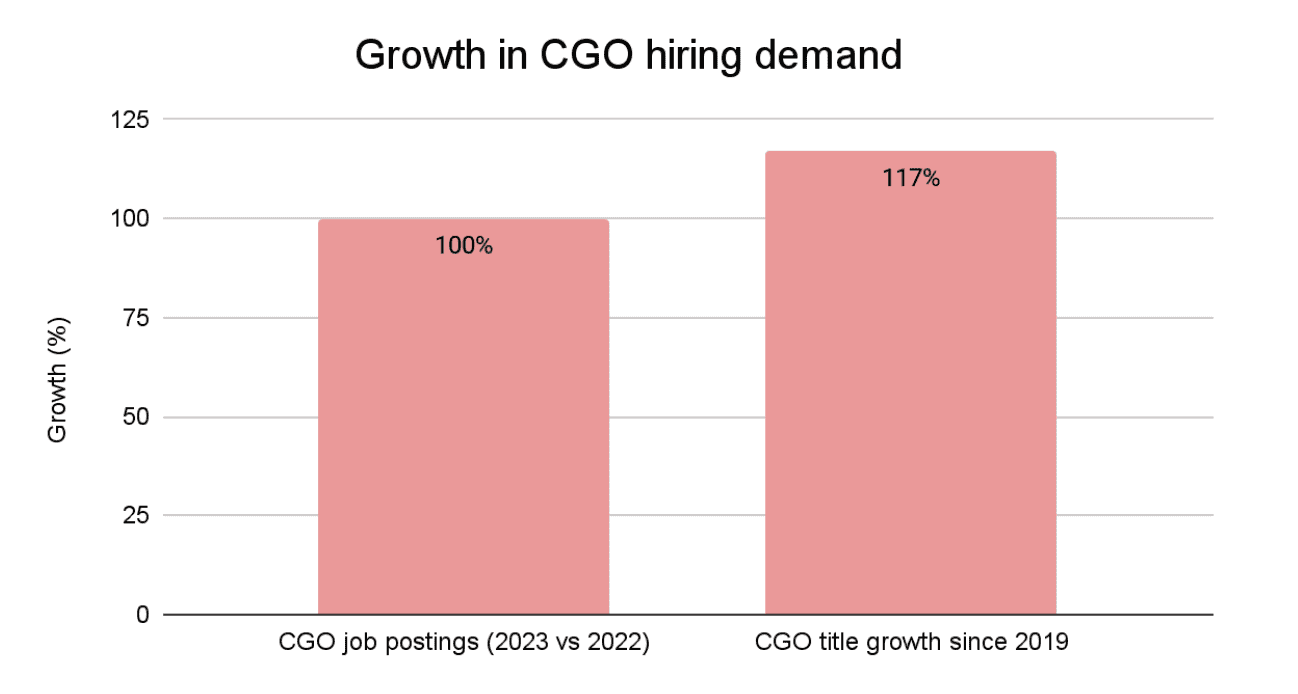
- Job postings for CGOs more than doubled in 2023 [2]
- Hiring for the title grew by an impressive 117.5% between 2019 and the end of 2022 [3]
This combination of low penetration and surging demand is rare for a senior executive role, signaling a pivotal moment for executive hiring. As growth becomes harder to manage through traditional functional ownership, which is often split across product, marketing, sales, pricing, and partnerships, many organizations find that no single executive owns the end-to-end growth strategy.
This analysis examines how the CGO role is evolving, where demand is rising fastest, and what its growth signals for executive hiring in 2026.
What a Chief Growth Officer Is (and Is Not)
A Chief Growth Officer is responsible for aligning and driving growth strategy across the enterprise. The role is cross-functional by design and outcome-driven in scope. In practice, a CGOs responsibilities typically include:
- Owning the revenue growth strategy across all channels
- Prioritizing competing growth initiatives to maximize impact
- Executing new levers for expansion, such as innovative pricing models, strategic partnerships, and market entry
A CGO is not a rebranded Chief Marketing Officer, nor are they a sales-only leader like a Chief Revenue Officer. The rise of specialist C-suite roles in recent years is a direct response to increasing organizational complexity rather than title inflation. As companies scale, leadership structures evolve to reflect how decisions are actually made and executed [2].
How Common Is the CGO Role Today?
Despite its increased visibility, the CGO role remains in the early stages of adoption. With only a small fraction of companies having a dedicated CGO, most organizations continue to manage growth through a combination of marketing, sales, product, and finance leadership rather than consolidating accountability under a single executive.
CGO adoption snapshot
Metric | Value |
Companies with a CGO | 14% |
Companies without a CGO | 86% |
Adoption stage | Early |
This doesn’t imply that companies undervalue growth leadership, but rather that many are still determining where that ultimate ownership should reside.
Why the CGO Role Is Growing Now
While adoption is still in its early phase, hiring momentum for CGOs is accelerating quickly. Chief Growth Officer job postings have more than doubled in 2023, making CGO one of the fastest-growing executive titles tracked in recent years [2].
This trend is reinforced by longer-term data showing a 117.5% increase in CGO hiring since 2019, placing it among the fastest-growing C-suite titles over the last several years[3].
This gap between adoption and demand suggests many organizations are moving from experimentation to active evaluation of the role.
Growth in CGO hiring demand
Several structural forces are driving this shift:
- Fragmented Ownership: In many organizations, growth is a disjointed effort. Marketing may own demand generation, sales owns bookings, product controls roadmap decisions, and finance sets pricing, but when priorities conflict, accountability is often unclear, slowing decision-making.
- Pressure for ROI: CEOs face mounting pressure to translate strategic investments, particularly in technology like AI, into tangible results. A recent PwC survey found that while 30% of CEOs report revenue gains from AI, 56% say they have yet to see financial benefits [4].
- Non-Linear Growth Paths: Growth is no longer a straight line. CGOs are increasingly expected to combine a visionary outlook with financial literacy and operational discipline to unlock new, unconventional growth avenues across the organization [5].
Industries Adopting CGOs Fastest
The CGO role tends to appear first in industries where growth depends on complex coordination rather than scale alone. Adoption has been highest in sectors like:
- Manufacturing
- Construction and infrastructure
- Automotive and electric vehicles
- Financial services
- Hospitality
These industries share common traits where growth decisions simultaneously impact product strategy, capital allocation, and go-to-market execution, thus increasing the value of centralized growth leadership [5].
CGO Backgrounds and Career Paths
There is no single path to becoming a CGO, but successful candidates often emerge from a few key backgrounds.
- Revenue leaders whose responsibilities expanded beyond traditional sales
- Product leaders with direct experience in monetization and P&L ownership
- Strategy leaders who have held roles with operational authority
- Founders and General Managers with a holistic understanding of the business
Across these profiles, a common skill set appears repeatedly. An analysis of the skills most frequently cited in CGO role descriptions highlights the importance of financial literacy, cross-functional leadership, data-driven decision making, and change management capabilities as foundational requirements [5].
What the Rise of the CGO Signals for Executive Hiring
The emergence of the CGO role reflects a broader shift in how companies think about leadership accountability.
For organizations evaluating whether to formalize growth ownership at the executive level, many turn to specialized executive search partners to help define the scope, leadership profile, and success criteria for the role. Talentfoot’s Executive Search Services provide support for companies navigating these increasingly complex leadership decisions. With an industry-leading 98% success rate, and a process that is 3x faster than the industry average, Talentfoot helps companies build the leadership teams they need to win.
Growth ownership is consolidating. Boards are prioritizing outcomes over titles. Hybrid executives who can bridge strategy and execution are becoming more valuable.
This aligns with Talentfoot’s broader tracking of evolving executive roles across industries.
For many organizations, the underlying question is simple. Is growth truly owned by one leader, or is it still distributed across functions?
When organizations decide to move from evaluation to action, executive hiring is often the next logical step. Contact us to speak with one of our experts.
Key Takeaways
- Only 14 percent of companies currently employ a Chief Growth Officer
- CGO job postings more than doubled in 2023
- CGO titles have grown by roughly 117 percent since 2019
- Adoption is highest in complex, multi-lever growth environments
- Executive hiring is shifting toward centralized growth accountability
FAQs When Hiring a GCO
Is the Chief Growth Officer replacing the CMO or CRO?
No. The CGO role is designed to coordinate growth across functions, including marketing and sales, rather than replacing their leadership.
Why are CGOs still uncommon if demand is rising so quickly?
Because the role is still being defined, and many organizations are clarifying scope and authority before formal adoption.
When does it make sense to hire a CGO?
It most often makes sense when growth ownership is fragmented and the leadership team needs a single executive to be accountable for prioritization and outcomes.
Sources
- Marketri, “What is a Chief Growth Officer, and Why Does You Need One?” August 6, 2025, https://marketri.com/resources/chief-growth-officer-description-and-overview/.
- SHRM, “Understanding the Modern C-Suite: Strategic Insights for HR Leaders,” December 6, 2024.
- George Anders, “Who’s vaulting into the C-suite? Trends changed fast in 2022,” LinkedIn, February 1, 2023.
- PwC, “29th Global CEO Survey: Leading through uncertainty in the age of AI,” January 19, 2026.
- The Economic Times, “Role of chief growth officer becomes prominent as companies look for growth avenues in an evolving world,” March 5, 2024.
- Talentfoot internal data